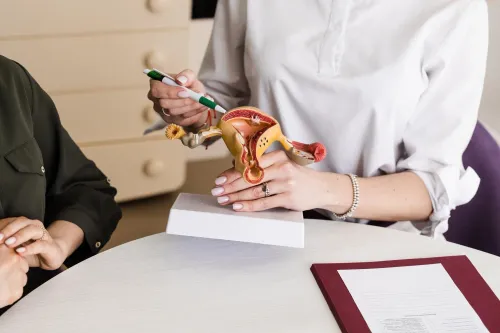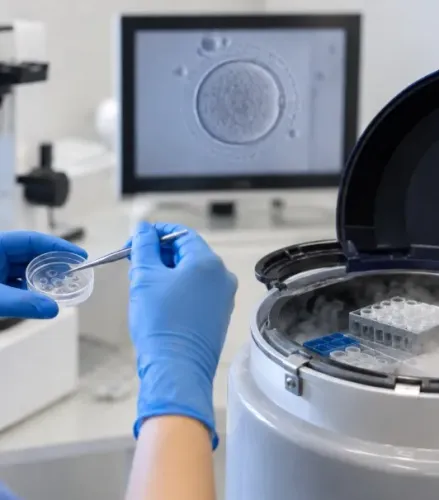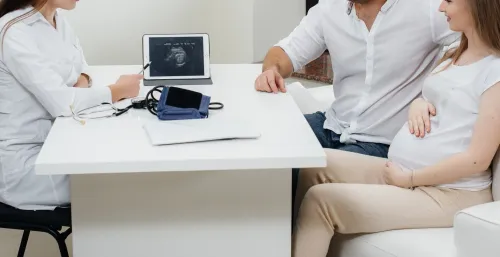
Not conceiving can result from ovulation, sperm, tubal, uterine, age-related or unexplained factors, and more than one cause can exist at the same time. By the end, you will know when to seek assessment, which tests clarify the cause, and how clinicians choose between medication, timed intercourse, IUI, surgery, IVF, donor gametes and fertility preservation.
Key takeaways
- Seek assessment after 12 months trying, or after 6 months if age 35 or older.
- Evaluate both partners because infertility can involve sperm, ovulation, tubes, uterus or other factors.
- Treatment may progress from medication and timed intercourse to IUI, surgery or IVF.
- Discuss donor treatment or fertility preservation when medical or age-related factors affect future fertility.
When does difficulty conceiving become infertility?
Infertility is generally defined as not achieving pregnancy after 12 months of regular unprotected intercourse. If the female partner is age 35 or older, arrange an assessment after 6 months age 35 or older rather than continuing to try without medical guidance.
Seek help sooner if the female partner is over 40, because fertility and egg quality decline with age.
Arrange an earlier appointment if either partner has:
- Irregular or absent periods, which can indicate inconsistent ovulation
- Severe pelvic pain, known endometriosis, prior pelvic infection or pelvic surgery
- Recurrent miscarriage or previous chemotherapy exposure
- Testicular problems, erectile difficulty, ejaculation problems or known abnormal semen results
- A history suggesting blocked fallopian tubes or another reproductive condition
When to seek infertility assessment is not determined only by the calendar. A clinician should evaluate both partners together, even when one partner has regular periods or no obvious symptoms. The initial review commonly includes medical, menstrual and sexual history, ovulation assessment, examination of the uterus and fallopian tubes, and at least one semen analysis.
That analysis measures sperm concentration, movement and shape; an abnormal result is often repeated because results vary between samples. Earlier evaluation prevents treatable problems from going unrecognised and helps match treatment to your age, health and reproductive goals.
What can cause infertility in either partner?
Infertility can arise from the female partner, the male partner, both, or neither identifiable cause. That is why both partners need evaluation rather than assuming the problem is primarily female.
- Female causes include ovulation disorders such as polycystic ovary syndrome, diminished ovarian reserve, age-related egg decline, blocked fallopian tubes, endometriosis, and uterine fibroids and polyps. Prior pelvic infection or surgery can also damage the tubes.
- Male-factor infertility includes low sperm production, testicular disease, hormonal disorders, erectile or ejaculation problems, medication effects, and genetic infertility factors. A semen analysis measures sperm concentration (number per millilitre), motility (movement), and morphology (shape and structure). Low values can reduce the chance that sperm will reach, penetrate, or fertilise an egg.
- Combined infertility means both partners have findings that reduce conception, such as irregular ovulation alongside poor sperm motility. Two smaller problems can create a substantial barrier together.
- Unexplained infertility is diagnosed when standard testing finds no clear cause, even though conception has not occurred. It does not mean the symptoms are imaginary; current tests cannot identify every problem involving egg quality, sperm function, fertilisation, or embryo development.
Seek assessment sooner for irregular or absent periods, severe pelvic pain, recurrent miscarriage, known endometriosis, chemotherapy exposure, testicular problems, or other fertility risks.
Which tests identify the cause of infertility?
Infertility diagnosis starts with both partners, not with tests for the female partner alone. A clinician reviews medical and sexual history, including previous pregnancies, contraception, pelvic infections, surgery, medications, intercourse frequency, erectile or ejaculation problems, and relevant family conditions.
Ovulation assessment begins with menstrual tracking. Regular cycles suggest, but do not prove, ovulation; ovulation testing detects the luteinising-hormone surge, while a blood progesterone test can confirm recent ovulation. Irregular or absent periods need targeted hormone testing and assessment for conditions such as polycystic ovary syndrome.
The main tests answer different questions:
| Test | What it helps show | What it cannot show |
|---|---|---|
| AMH | Estimated remaining follicle pool and likely response to ovarian stimulation | Natural conception ability or egg quality |
| Antral follicle count | Follicle number seen on pelvic ultrasound | Embryo chromosome health or guaranteed pregnancy |
| Pelvic ultrasound | Ovaries, fibroids, polyps, cysts and uterine structure | Whether fallopian tubes are open |
| Hysterosalpingography | Whether the uterus is shaped normally and tubes allow dye to pass | Egg quality or sperm function |
| Semen analysis | Sperm concentration, motility and morphology | Every cause of male infertility |
A semen analysis is an early, high-yield test; repeat it after an abnormal result because values vary between samples. Routine sperm DNA-fragmentation testing is not usually part of the initial evaluation. Low AMH or antral follicle count mainly predicts egg numbers during stimulation, not egg quality; age is a stronger predictor of chromosome-related risk.
How do medication, timed intercourse, IUI and surgery fit into treatment?
Treatment choice depends on where fertilization can occur, whether ovulation is reliable, and how much intervention is justified. Timed intercourse and medication leave fertilization to occur inside the fallopian tube; IUI places prepared sperm in the uterus but still requires at least one open tube.
| Option | Fertilization and purpose | Monitoring and invasiveness |
|---|---|---|
| Timed intercourse | Fertilization occurs in the tube; useful when ovulation and semen findings are adequate | Ovulation timing; least invasive |
| Ovulation induction | Stimulates egg release for intercourse; letrozole is first-line for many people with PCOS-related anovulation, while clomiphene citrate is an alternative in selected cases | Ultrasound and hormone treatment monitoring; tablets are less invasive |
| IUI | Prepared sperm is placed in the uterus, then fertilization occurs in the tube; useful for selected unexplained or mild male-factor infertility | Ovulation scans, sometimes medication; a catheter procedure |
| Infertility surgery | Does not fertilize an egg; hysteroscopy can remove a polyp, while laparoscopy can treat selected endometriosis or assess tubal patency | Operative risks and recovery; use only when correcting a specific problem could improve conception |
Gonadotropin injections stimulate several follicles and require close scans. A trigger injection releases a mature egg, but the cycle may be cancelled if too many follicles create a multiple-pregnancy risk. Progesterone support is prescribed when luteal support is indicated, not as a universal fertility treatment.
For unexplained infertility, repeated medication with timed intercourse alone is not equivalent to stimulated IUI. A limited course of stimulation plus IUI may come first, followed by IVF if it fails. The number of cycles depends on age, prognosis and prior response.
When is IVF, donor treatment or fertility preservation the next step?
When IVF is recommended depends on the cause, age and time available. Blocked or severely damaged tubes, severe sperm abnormalities, diminished ovarian reserve, endometriosis, or unsuccessful prior treatment can move you to IVF sooner. IVF cannot reliably reverse age-related egg-quality decline, so ask how ovarian reserve and embryo chromosome risk affect your prognosis.
- For unexplained infertility, discuss a limited course of ovarian stimulation with IUI before IVF, rather than repeating medication and timed intercourse indefinitely. The number of cycles depends on age, prognosis and previous response.
- Consider donor eggs when egg supply or egg quality makes treatment with your own eggs unlikely to produce a live birth. Donor sperm may help with absent sperm, severe male-factor infertility or an inherited condition; discuss genetic screening, legal documentation and counselling.
- Choose fertility preservation before chemotherapy or pelvic treatment, or when you want to delay pregnancy and still have useful ovarian reserve. Ask whether freezing eggs, embryos or sperm fits your age, partner status and future plans.
Ask about the multiple pregnancy risk from gonadotropins and embryos, including dose changes, cycle cancellation and elective single-embryo transfer. PGT-A may identify chromosome-number abnormalities in embryos, but it does not guarantee implantation or a live birth.
At Deshmukh Maternity Hospital, ask whether IVF success rates are reported per cycle started, retrieval or transfer, and whether they show age-specific live birth rates rather than only positive pregnancy tests.
Related services
IVF Treatment What Is IVF? In Vitro Fertilization (IVF) is a groundbreaking fertility treatment that offers hope to individuals and couples facing infertility. View service → |
IUI Treatment At Deshmukh Hospital & IVF Center, we provide safe, affordable, and personalized Intrauterine Insemination (IUI) Treatment for couples facing... View service → |
Frequently asked questions
When does difficulty conceiving become infertility?
Infertility is generally defined as not achieving pregnancy after 12 months of regular unprotected intercourse. Seek assessment after 6 months when the female partner is age 35 or older.
What can cause infertility in either partner?
Causes can involve ovulation, ovarian reserve, fallopian tubes, the uterus, sperm production or sperm movement. Some cases remain unexplained after testing.
Which tests identify the cause of infertility?
Evaluation can include a semen analysis, ovulation assessment, hormone tests, ovarian-reserve testing, pelvic ultrasound and tests for fallopian-tube blockage.
How do medication, timed intercourse, IUI and surgery fit into treatment?
Treatment depends on the cause. Medication can support ovulation, timed intercourse targets the fertile window, IUI places prepared sperm in the uterus, and surgery addresses selected structural problems.
When is IVF, donor treatment or fertility preservation the next step?
IVF may follow unsuccessful simpler treatments or suit blocked tubes, severe sperm problems or reduced ovarian reserve. Donor treatment and fertility preservation are considered when using stored eggs, sperm or embryos, or donor eggs or sperm, supports the family-building plan.
Related services
Embryo Transfer What Is Embryo Transfer? Embryo Transfer is the pivotal step in the In Vitro Fertilization (IVF) process, where carefully selected embryos are placed... View service → |
Gynecological Consultations & Treatments Gynecological Consultations & Treatments Comprehensive Care for Every Stage of Womanhood At Deshmukh Maternity Hospital, we are dedicated to providing expert gynecological care tailored to... View service → |
General Consultation General Consultation |